Author: Sarah Shoilee

Exhibition: Imagine – the future of human remains from colonial contexts in Museum Vrolik
No Comments

English version

March 13 2026 – June 27 2027

The preservation and exhibition of human remains in museums is a painful open wound for many descendant communities, especially those from former colonies. Any museum that stewards such human remains, like Museum Vrolik, must respond to its racist and colonial inheritance, including by researching the provenance of the remains and sharing the findings. The result can be seen in the exhibition: ‘Imagine – the future of human remains of colonial contexts in Museum Vrolik.

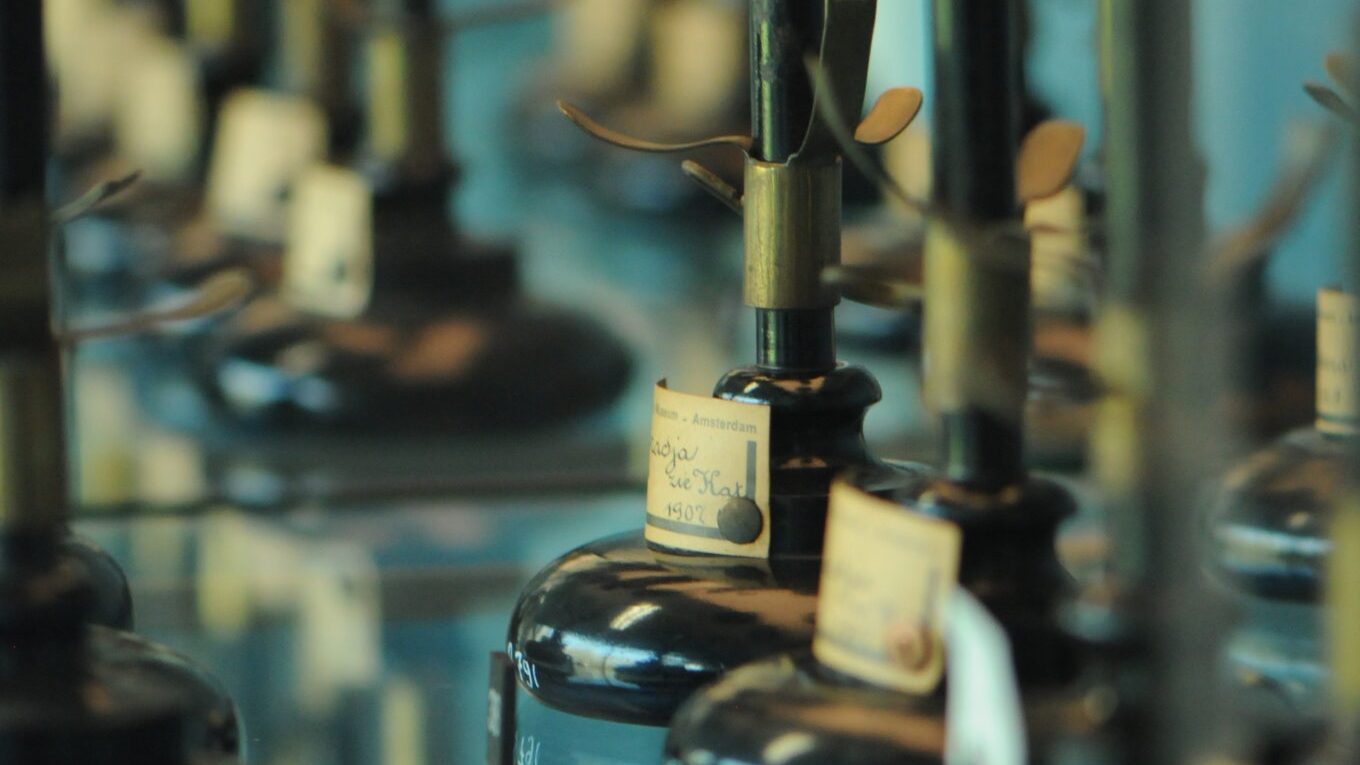
Imagine a future in which all racialized human remains find a final resting place. What remains? Display cases with empty stands and labels – direct evidence of the racial collecting mania of Museum Vrolik’s anatomists in the nineteenth and early twentieth centuries. These objects are essential, as they will show future generations how medical doctors contributed to racist and colonial science. Through captions linked to stands, we move beyond the objectification and racial categorization of remains, showing their humanity and, at the very least, to tell their histories.

The five-year project ‘Pressing Matter, ownership, value and the question of colonial heritage in museums’ included provenance research on these human remains. Investigation of archives and publications, museum labels and catalogues, and even inscriptions on the remains themselves revealed a great deal of information. Communities of origin, including diaspora communities, were involved in the research. They provided many answers, and new insights, such as about the important, enduring spiritual connection between ancestors and present-day communities. Menucha Latumaerissa of the Dutch Foundation Budaya Kita: “I found a book by Kleiweg-de Zwaan in a thrift store. It turned out to contain images of the skulls of our Moluccan ancestors. Through various channels, we were able to trace the remains to Museum Vrolik. Last year, through the Budaya Kita Foundation, we were able to bring the remains of our ancestors home.”

An important goal of this project was to begin healing the wounds of colonial injustice and scientific racism. We do so by addressing these histories openly, and, above all, by working with communities of origin to find the best resting place for the remains of their ancestors. For some, that means restitution. Nonetheless, provenance research on the remains continues. Healing colonial injustice requires care and patience – and may never be fully completed.

The exhibition Imagine – the future of human remains of colonial origin at Museum Vrolik will be on display from Friday, March 13, 2026, at:

Museum Vrolik, Amsterdam UMC location AMC, Meibergdreef 15, Amsterdam, The Netherlands.

For more information visit: https://www.museumvrolik.nl/en/visit-the-museum/exhibition-imagine.

Dutch version

Verbeeld je – de toekomst van menselijke overblijfselen van koloniale herkomst in Museum

Vrolik


13 maart 2026 – 27 juni 2027


Voor veel nazaten van menselijke overblijfselen uit voormalige koloniën is het bewaren en tentoonstellen van deze voorouderlijke overblijfselen in musea een pijnlijke open wond. Maar een museum dat zulke overblijfselen beheert, moet wel iets doen met deze erfenis van kolonialisme en racisme. Voor Museum Vrolik betekent dit dat we de herkomst van de overblijfselen onderzoeken. Het resultaat is te zien in de tentoonstelling ‘Verbeeld je – de toekomst van menselijke overblijfselen van koloniale herkomst in Museum Vrolik.’


Verbeeld je een situatie waarin alle geracialiseerde overblijfselen hun laatste rustplaats gevonden hebben: vitrines met lege standaarden en labels als belangrijke getuigenissen van de raciale verzameldrift van de negentiende- en begin twintigste-eeuwse anatomen van Museum Vrolik. Essentiële objecten omdat ze toekomstige generaties zullen helpen herinneren hoezeer medici bijdroegen aan racistische en koloniale wetenschap. Via beschrijvingen bij de standaarden proberen we de menselijke overblijfselen, ooit geracialiseerd en gereduceerd tot object, weer tot menselijk individu terug te brengen en op zijn minst over hun herkomst te vertellen.


Tijdens het vijfjarige project Pressing Matter, ownership, value and the question of colonial heritage in museums zijn de menselijke overblijfselen onderzocht. Veel informatie is gevonden in archieven en oude publicaties, op labels, nummers en handschriften op de overblijfselen. Ook betrokkenheid van herkomstgemeenschappen, inclusief diaspora gemeenschappen, heeft veel antwoorden gebracht. Maar ook nieuwe inzichten: hoe belangrijk bijvoorbeeld de spirituele band nog steeds is tussen voorouders en de huidige gemeenschappen. Menucha Latumaerissa van Stichting Budaya Kita: “Ik vond in een kringloopwinkel een boekje van Kleiweg-de Zwaan. Daarin bleken schedels van onze Molukse voorouders afgebeeld. Via via hebben we kunnen achterhalen dat de overblijfselen in Museum Vrolik werden bewaard. Afgelopen jaar hebben we via Stichting Budaya Kita de overblijfselen van onze voorouders naar huis kunnen brengen”.


Een belangrijk doel van het project Pressing Matter was om een start te maken met het helen van de wonden van koloniaal onrecht en wetenschappelijk racisme. Dat doen we niet alleen door deze geschiedenissen te delen, maar vooral door samen met herkomstgemeenschappen te zoeken naar wat nu de beste bestemming is voor voorouderlijke overblijfselen. Voor sommigen is dat restitutie. Het herkomstonderzoek gaat echter door. Het helen van het koloniale onrecht is een proces dat zorgvuldigheid en geduld vraagt – en misschien wel nooit helemaal af is.


De tentoonstelling Verbeeld je – de toekomst van menselijke overblijfselen van koloniale herkomst in Museum Vrolik is vanaf vrijdag 13 maart 2026 te zien bij:


Museum Vrolik, Amsterdam UMC locatie AMC, Meibergdreef 15, Amsterdam.

Voor meer informatie bezoek: https://www.museumvrolik.nl/en/visit-the-museum/exhibition-imagine.
Best Paper Award for Enhancing Provenance Research with Linked Data

No Comments

We are thrilled to share that our paper, Enhancing Provenance Research with Linked Data: A Visual Approach to Knowledge Discovery, has been awarded Best Paper at the SemDH 2025 Workshop (Second International Workshop of Semantic Digital Humanities), held at the ESWC 2025 Conference in Portorož, Slovenia.

This work is the result of a collaboration between Vrije Universiteit Amsterdam and Aalto University in Finland, supported by Sarah Shoilee’s research visit to Aalto in early 2025 as part of her PhD within the Pressing Matter project. In addition, the work was nominated for Best Demo at the ESWC 2025 conference, where Victor de Boer (PI of work package 1b) received the Best Reviewer Award for the Resource Track.

Overall, participating in ESWC—one of the leading conferences in the field of Semantic Web technologies—was a rewarding experience for the Pressing Matter team. This recognition underscores the value of interdisciplinary collaboration and the increasing relevance of semantic technologies within the Digital Humanities, offering encouraging opportunities for future research and exchange.

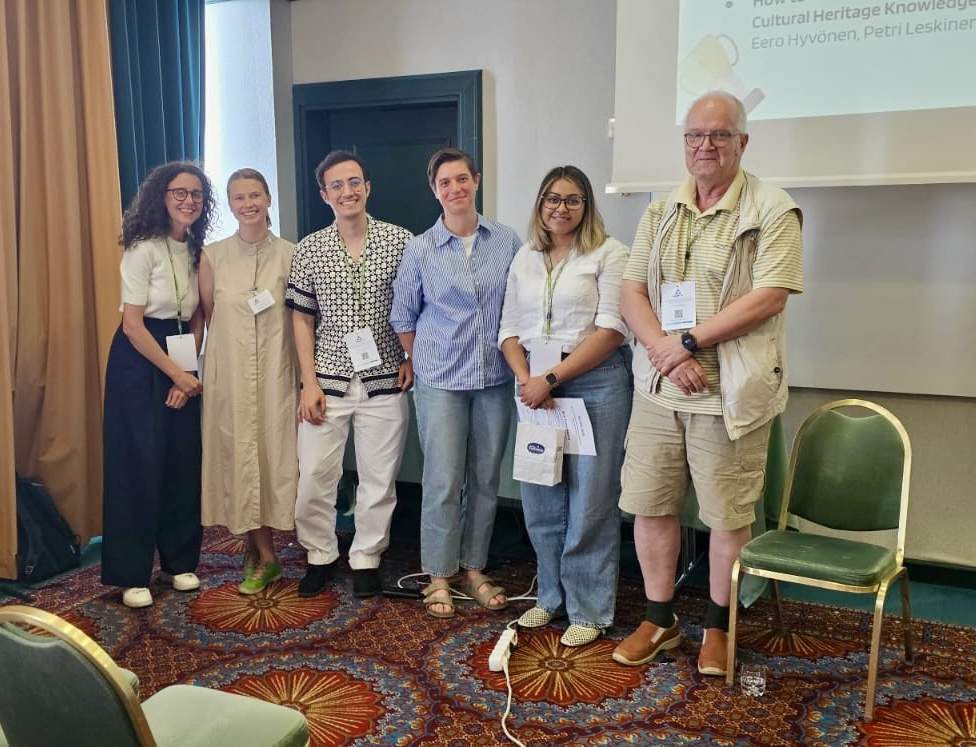
SemDH organizers together with Sarah Shoilee (PhD Candidate, Vrije Universiteit Amsterdam, Pressing Matter project) and Eero Hyvönen (Aalto University, Finland).

About the Research

One of the most pressing challenges in provenance research—especially in the context of colonial collections—is the fragmentary, incomplete, and often ambiguous nature of the historical records. Many provenance chains are broken, partially documented, or scattered across different archives, making it difficult to reconstruct the full narrative of an object’s biography.

This research aims to tackle this issue by using Linked Data and semantic exploration tools to:

  • Expose gaps and uncertainties in the provenance records through user-friendly interface instead of concealing them.
  • Support researchers in navigating incomplete data through visual tools like timelines, maps, and networks that help identify missing links, time periods with sparse information, and disconnected nodes in provenance chains.
  • Enable semantic exploration, where incomplete records can be viewed in the broader context of related people, places, and historical events, encouraging critical questioning and further investigation.

Rather than aiming to “complete” the provenance data, PM-Sampo makes the incompleteness itself visible and researchable, which is the technological contribution of the paper. By acknowledging and foregrounding these gaps, we aim to foster transparency, encourage scholarly reflection, and open up new avenues for collaborative knowledge building.

Peter Pels, Marleen Witte and Susan Legêne will speak at 55 jaar KDC – Jan Roes-lezing

No Comments

On May 31, 2024, the Katholiek Documentatie Centrum (KDC) will celebrate its 55th anniversary. Traditionally, the Jan Roes lecture is given on an anniversary. This year, Prof. Dr. Susan Legêne, historian at the Vrije Universiteit Amsterdam, has been invited to speak. She is intensively concerned with the question of how colonial objects can contribute to a responsible handling of the colonial past and its impact on current and future society.

This subject was also close to the heart of Jan Roes (1939-2003), the first KDC director. On his initiative, the archives of the Archdiocese of Jakarta (1807-1975) were made accessible to researchers at home and abroad. He is at the forefront of efforts to safeguard the shared Catholic heritage of Indonesia and the Netherlands for conservation and research.

The KDC wants to make an important contribution within the field of dealing with colonial history. The aim is to contribute to reconciliation in historically complex social relationships and thus promote equality among a multitude of population groups in society.

Different voices can be heard in and about the colonial past. Prof. Legêne will illustrate how this layering can be discovered. Representatives of communities of origin, heritage professionals, researchers and other stakeholders then respond. They supplement the argument with their experiences about the value and application of these insights in decolonizing archives.

The invitation and details of this event can be found in the attachment.

Pressing Matter Biannual Consortium – June 16, 2023

One of the aims of the Pressing Matter project was to think through provenance its meanings and methods, with a special interest in the question of provenance across different institutional/academic frames, mindful of the fact that much of the provenance practices have been oriented towards art historical research. The theme of this consortium was ‘Provenance Matters’, reflecting on the question of provenance and its potential and limitations.

As a basis for the consortium, the provenance researchers in the Pressing Matter team (François Janse van Rensburg, Karwin Cheung, Laetitia Lai and Micaela Cabrita da Palma) prepared a position paper Provoking Provenance. In this volume the provenance researchers aimed to provide perspectives from the field, and informed by their experiences, to provoke discussion on both the potentialities and limitations of provenance research and its ability to contribute to the broader reckoning with the colonial past. The position paper is expected to be available and downloadable on this website by mid-2024.

The topics at the consortium:

  • Provoking Provenance – by François Janse van Rensburg, Senior Provenance Researcher, Pressing Matter
  • An investigation into anonymous objects – by Karwin Cheung, Senior Provenance Researcher, Pressing Matter
  • Polyvocal Knowledge Modelling for Colonial Object Provenance – by Sarah Shoilee, PhD Candidate, Pressing Matter
  • PROLAB: The Provenance of Looted and Lost Art – by Diederik Oostdijk, Professor English & American Literature, VU & PROLAB
  • Sociology, ecology, and provenance research in book history – by Nelleke Moser, Director Graduate School of Humanities, VU and Associate Professor of Literature & Society
  • Artist based provenance in Mexico – by Daniel Aguilar Ruvalcaba, Artist in Residence Pressing Matter
  • Culture Under Attack, Genocide Under Scrutiny. Re-centering culture and revisiting the concept of ‘cultural genocide’ – by Martijn Eickhoff, PI Pressing Matter, director of the NIOD institute for War, Holocaust and Genocide Studies, and Endowed Professor of Archaeology and Heritage of War and Mass Violence at the University of Groningen
  • Human and other primate remains in provenance research – by Laurens de Rooy, PI Pressing Matter and director and curator of Museum Vrolik

The following video is a summary by Programme Leader Prof. Dr .Wayne Modest of the Pressing Matter Biannual Consortium on Friday 16 June 2023.