Exhibition: Imagine – the future of human remains from colonial contexts in Museum Vrolik
English version
March 13 2026 – June 27 2027
The preservation and exhibition of human remains in museums is a painful open wound for many descendant communities, especially those from former colonies. Any museum that stewards such human remains, like Museum Vrolik, must respond to its racist and colonial inheritance, including by researching the provenance of the remains and sharing the findings. The result can be seen in the exhibition: ‘Imagine – the future of human remains of colonial contexts in Museum Vrolik.’
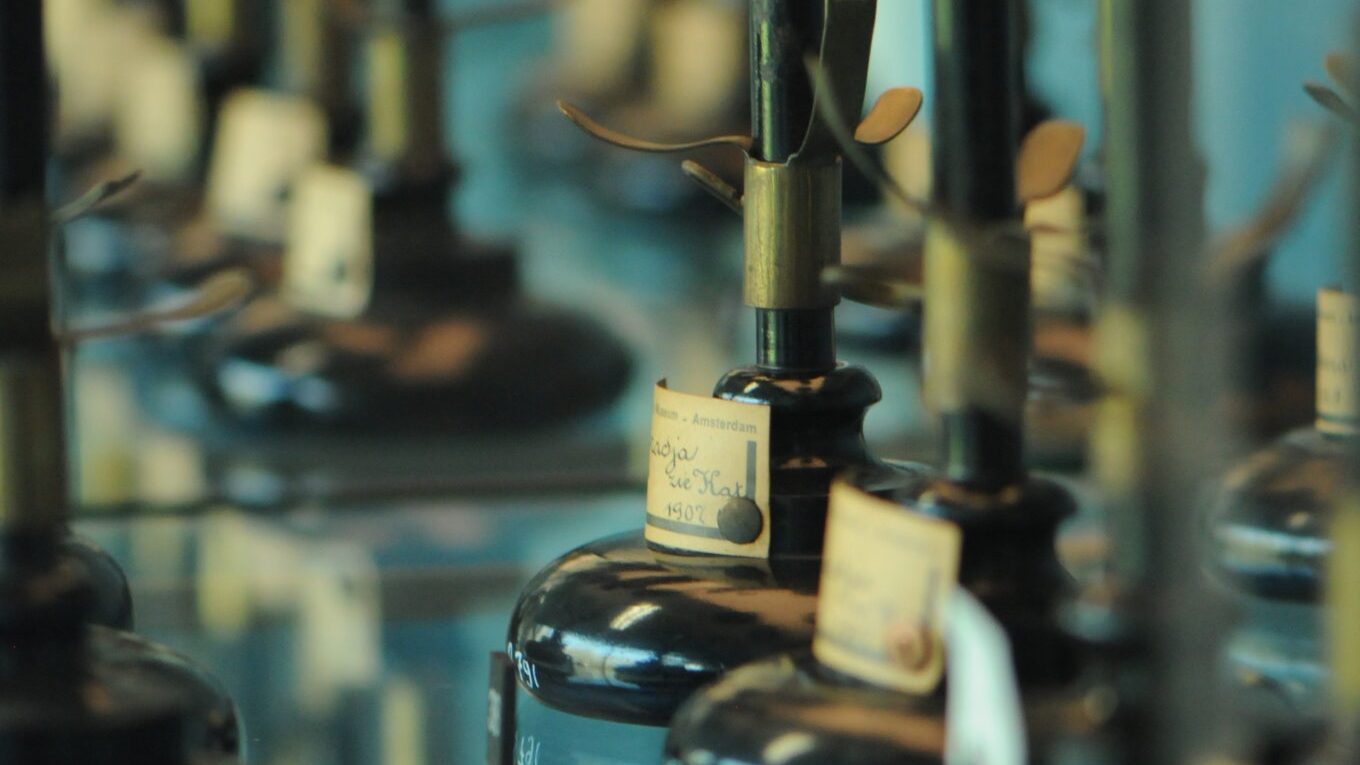
Imagine a future in which all racialized human remains find a final resting place. What remains? Display cases with empty stands and labels – direct evidence of the racial collecting mania of Museum Vrolik’s anatomists in the nineteenth and early twentieth centuries. These objects are essential, as they will show future generations how medical doctors contributed to racist and colonial science. Through captions linked to stands, we move beyond the objectification and racial categorization of remains, showing their humanity and, at the very least, to tell their histories.
The five-year project ‘Pressing Matter, ownership, value and the question of colonial heritage in museums’ included provenance research on these human remains. Investigation of archives and publications, museum labels and catalogues, and even inscriptions on the remains themselves revealed a great deal of information. Communities of origin, including diaspora communities, were involved in the research. They provided many answers, and new insights, such as about the important, enduring spiritual connection between ancestors and present-day communities. Menucha Latumaerissa of the Dutch Foundation Budaya Kita: “I found a book by Kleiweg-de Zwaan in a thrift store. It turned out to contain images of the skulls of our Moluccan ancestors. Through various channels, we were able to trace the remains to Museum Vrolik. Last year, through the Budaya Kita Foundation, we were able to bring the remains of our ancestors home.”
An important goal of this project was to begin healing the wounds of colonial injustice and scientific racism. We do so by addressing these histories openly, and, above all, by working with communities of origin to find the best resting place for the remains of their ancestors. For some, that means restitution. Nonetheless, provenance research on the remains continues. Healing colonial injustice requires care and patience – and may never be fully completed.
The exhibition Imagine – the future of human remains of colonial origin at Museum Vrolik will be on display from Friday, March 13, 2026, at:
Museum Vrolik, Amsterdam UMC location AMC, Meibergdreef 15, Amsterdam, The Netherlands.
For more information visit: https://www.museumvrolik.nl/en/visit-the-museum/exhibition-imagine.
Dutch version
Verbeeld je – de toekomst van menselijke overblijfselen van koloniale herkomst in Museum
Vrolik
13 maart 2026 – 27 juni 2027
Voor veel nazaten van menselijke overblijfselen uit voormalige koloniën is het bewaren en tentoonstellen van deze voorouderlijke overblijfselen in musea een pijnlijke open wond. Maar een museum dat zulke overblijfselen beheert, moet wel iets doen met deze erfenis van kolonialisme en racisme. Voor Museum Vrolik betekent dit dat we de herkomst van de overblijfselen onderzoeken. Het resultaat is te zien in de tentoonstelling ‘Verbeeld je – de toekomst van menselijke overblijfselen van koloniale herkomst in Museum Vrolik.’
Verbeeld je een situatie waarin alle geracialiseerde overblijfselen hun laatste rustplaats gevonden hebben: vitrines met lege standaarden en labels als belangrijke getuigenissen van de raciale verzameldrift van de negentiende- en begin twintigste-eeuwse anatomen van Museum Vrolik. Essentiële objecten omdat ze toekomstige generaties zullen helpen herinneren hoezeer medici bijdroegen aan racistische en koloniale wetenschap. Via beschrijvingen bij de standaarden proberen we de menselijke overblijfselen, ooit geracialiseerd en gereduceerd tot object, weer tot menselijk individu terug te brengen en op zijn minst over hun herkomst te vertellen.
Tijdens het vijfjarige project Pressing Matter, ownership, value and the question of colonial heritage in museums zijn de menselijke overblijfselen onderzocht. Veel informatie is gevonden in archieven en oude publicaties, op labels, nummers en handschriften op de overblijfselen. Ook betrokkenheid van herkomstgemeenschappen, inclusief diaspora gemeenschappen, heeft veel antwoorden gebracht. Maar ook nieuwe inzichten: hoe belangrijk bijvoorbeeld de spirituele band nog steeds is tussen voorouders en de huidige gemeenschappen. Menucha Latumaerissa van Stichting Budaya Kita: “Ik vond in een kringloopwinkel een boekje van Kleiweg-de Zwaan. Daarin bleken schedels van onze Molukse voorouders afgebeeld. Via via hebben we kunnen achterhalen dat de overblijfselen in Museum Vrolik werden bewaard. Afgelopen jaar hebben we via Stichting Budaya Kita de overblijfselen van onze voorouders naar huis kunnen brengen”.
Een belangrijk doel van het project Pressing Matter was om een start te maken met het helen van de wonden van koloniaal onrecht en wetenschappelijk racisme. Dat doen we niet alleen door deze geschiedenissen te delen, maar vooral door samen met herkomstgemeenschappen te zoeken naar wat nu de beste bestemming is voor voorouderlijke overblijfselen. Voor sommigen is dat restitutie. Het herkomstonderzoek gaat echter door. Het helen van het koloniale onrecht is een proces dat zorgvuldigheid en geduld vraagt – en misschien wel nooit helemaal af is.
De tentoonstelling Verbeeld je – de toekomst van menselijke overblijfselen van koloniale herkomst in Museum Vrolik is vanaf vrijdag 13 maart 2026 te zien bij:
Museum Vrolik, Amsterdam UMC locatie AMC, Meibergdreef 15, Amsterdam.
Voor meer informatie bezoek: https://www.museumvrolik.nl/en/visit-the-museum/exhibition-imagine.